Cyber Security News Aggregator
.Cyber Tzar
provide acyber security risk management
platform; including automated penetration tests and risk assesments culminating in a "cyber risk score" out of 1,000, just like a credit score.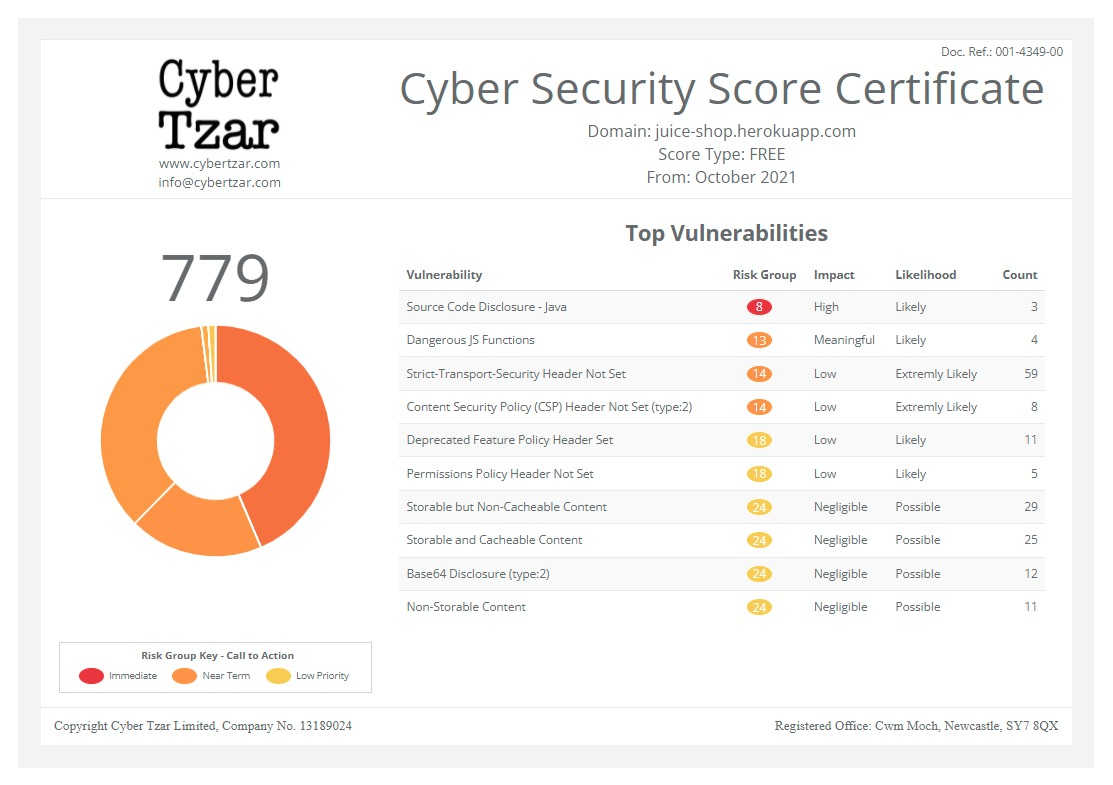
First slide label
Some representative placeholder content for the first slide.
Second slide label
Some representative placeholder content for the second slide.
Third slide label
Some representative placeholder content for the third slide.
Security leadership for what comes next
published on 2026-06-09 15:12:18 UTC by Mark FletcherContent:
The UK’s security leadership community will reconvene in Manchester this month at SJUK Leaders in Security 2026 – in association with HID – bringing together senior practitioners, policymakers and innovators to address the sector’s most pressing challenges
In 2026, events like SJUK Leaders in Security matter more than ever. Not because the sector is under strain, but because it is evolving at pace – and in plain sight.
Security is no longer adapting at the margins of change but is increasingly embedded within it. The operating environment continues to be reshaped by technological acceleration, from AI-enabled systems and cyber-physical convergence to automation and data-driven decision-making, creating both capability uplift whilst introducing new risks that demand sharper thinking.
At the same time, geopolitical instability, economic volatility and shifting risk patterns are forcing organisations to become more deliberate about how they define, prioritise and resource security.
Recent findings in the World Security Report reflect this, with 44% of CSOs saying economic instability will be the top security-impacting hazard throughout this year.
What does this all mean? It is not simply that businesses and individuals are facing increased exposure, but that they are operating within a more complex and interconnected risk landscape where traditional assumptions are less reliable and cross-domain understanding is key.
Industry leaders are central to strategic and operational decision-making, functioning as an enabling capability within the organisational ecosystem.
As roles and expectations continue to change, leaders need to assess their leadership posture, engage actively with their operating environment and learn from fellow practitioners who are directly shaping the future of the discipline.
SJUK Leaders in Security creates the conditions for this level of engagement, providing a platform for critical debates and key conversations.
John Mason to set the tone with 2026 Keynote Address
John Mason – CEO of PPL, the sophisticated electronic trading and placing platform that sits at the heart of the Lloyds of London speciality insurance market – has been confirmed as the Keynote Speaker for this year’s SJUK Leaders in Security Conference.
Described by Conference Chair, Rick Mounfield, as the C-Suite leader that we aim to influence, John’s 2026 Keynote Address will examine the financial environment as a key element of UK critical national infrastructure, exploring the diversity and increasing frequency of threats to the UK and considering how the UK might mobilise to address them.
Prior to PPL, he was a Managing Director at the London Stock Exchange Group (LSEG), responsible for the underlying data platforms that support super-fast data aggregation. For context, these process up to quarter of a million updates a second disseminated to over 250,000 desktop environments in real and non-real time.
John has held senior positions at Thomson Reuters, Refinitiv and Bloomberg, and has worked with Defence to provide strategic analysis of geopolitical, economic and security risk.
He has advised policy teams and helped create a new capability within the MoD to combat economic threat.
His involvement as Keynote Speaker reflects the relevance of his experience at the intersection of financial markets, critical data infrastructure and national security.
Moreover, in a world defined by accelerating technological change, his career offers a rare systems-level perspective on how critical infrastructure operates under pressure and at scale.
Leadership, governance and a tech-enabled future
Across the day, expert speakers will explore a set of interconnected themes that reflect how security is evolving.
A key focus will be the impact of AI and data-driven systems on leadership and decision-making, including the growing interdependence between human judgement and machine intelligence and the implications this has for accountability, oversight and design.
Alongside this will be a critical examination of AI in practice and the importance of proportionate, partnership-led deployment of technology.
Contributors will explore the risks of over-reliance and cultural resistance, alongside the need to maintain critical thinking as automation becomes further embedded across security operations.
Procurement and standards is another central theme, with discussions centred on how organisations can make more transparent, responsible and risk-aware security purchasing decisions in a landscape shaped by rising expectations around compliance, governance and public protection.
The programme also considers the evolving nature of the profession itself, from shifting entry routes and generational change to the ongoing challenge of defining professionalism, capability and progression in a modern security context.
A separate focus on entrepreneurship will also take centre stage, exploring how experience-led thinking is being translated into practical solutions.
Elsewhere, a fireside session will explore how rapidly evolving technologies are reshaping national security, risk and the balance of power between states, individuals and the private sector.
This chat will examine how developments in data, financial systems, information flows and automation are creating vulnerabilities and enabling threats that exploit these shifts, increasing pressure on leaders to manage fast-moving risks in an unpredictable geopolitical environment.
Another thought-provoking session explores how robotics, drones and autonomous systems are transforming security and conflict, drawing on real-world deployments to highlight the accelerating pace of innovation.
It considers the evolving balance between offensive and defensive capabilities and the growing gap between technological possibility and organisational readiness, emphasising the need for adaptive, technology-enabled approaches to resilience and security leadership.
Collaboration is key
Discussions at SJUK Leaders in Security 2026 underline a sector in active transition, where technological growth, geopolitical uncertainty and evolving risk expectations are reshaping security.
The programme highlights the need for sharper judgement, stronger collaboration and more adaptive leadership in an increasingly complex operating environment.
Want to explore the full conference agenda? Register now for your opportunity to attend on 24 June 2026 at The Manchester Deansgate Hotel, Manchester, UK
Featured Speakers
‘Communications in Crises’, presented by Beatrice Timpson & Rachel Miller, Sanctuary Counsel
When a crisis hits, the technical response is often only half the battle – the other half is responding in the court of public opinion. Join Beatrice Timpson (ex-No. 10) and Rachel Miller from Sanctuary Counsel for a “behind-the-curtain” look at how to communicate through a crisis.
Through case studies – ranging from international cyber-breaches to physical site disasters – we’ll explore the real time pressures of strategic decision-making and the friction of legal constraints.
You’ll gain actionable insights on the “dos and don’ts” of crisis comms and discover why a security plan is only truly robust when operations and communications are in total lockstep.
‘Systems Thinking for Security Leaders’, presented by Simon Goatcher, Chartered Chemist, Fellow of the Security Institute & Advanced Systems Thinking Practitioner
In complex and evolving security environments, the difference often lies in how we think, not just what we do.
While most professional development focuses on tactical execution, effective leadership requires the ability to navigate complexity and see the broader context.
This session builds on the instinctive strengths many security leaders already possess, exploring security challenges through the lens of systems thinking.
The aim is to help you see problems more clearly, frame them more effectively, and equip your teams to understand the bigger picture so they can perform at their best.
https://securityjournaluk.com/security-leadership-for-what-comes-next/
Published: 2026 06 09 15:12:18
Received: 2026 06 09 15:33:10
Feed: Security Journal UK
Source: Security Journal UK
Category: Security
Topic: Security
Views: 2
