Cyber Security News Aggregator
.Cyber Tzar
provide acyber security risk management
platform; including automated penetration tests and risk assesments culminating in a "cyber risk score" out of 1,000, just like a credit score.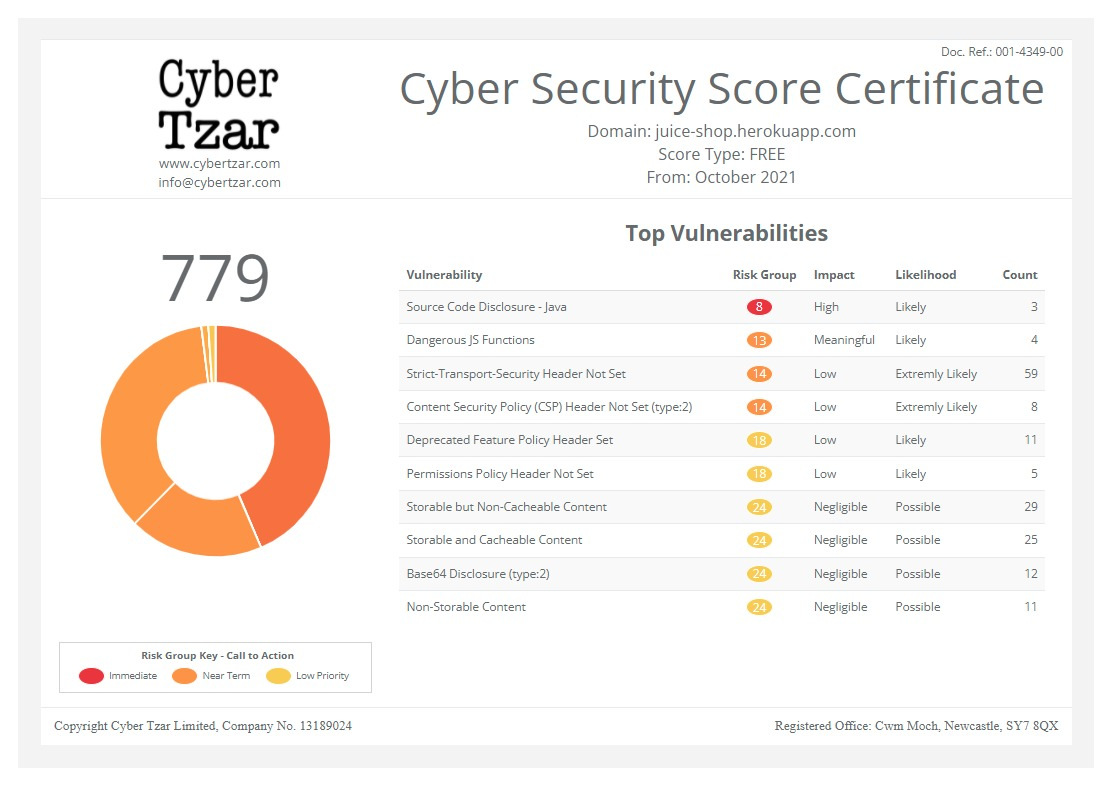
First slide label
Some representative placeholder content for the first slide.
Second slide label
Some representative placeholder content for the second slide.
Third slide label
Some representative placeholder content for the third slide.
AI, public safety and innovation in practice
published on 2026-06-10 08:00:00 UTC by Mark FletcherContent:
Rosie Richardson, Strategy Director at Createc, discusses her journey through the industry, her perspectives on security and public safety, innovation and the value of SJUK Leaders in Security
You’re passionate about creating social value through technology. Can you tell us about your career journey and what has shaped your perspective?
My route into security and technology was not conventional. I have a master’s degree in biology and was always fascinated by the natural world, especially the way complex systems and behaviours emerge.
I didn’t pursue life sciences, but that curiosity about how systems behave has stayed with me throughout my varied career. I originally started in marketing, moved into product roles and eventually into technology and innovation.
That progression taught me how to connect technical capability with real user needs and operational outcomes, and it has given me a broader perspective on how innovation succeeds in practice.
A lot of my perspective has been shaped by working with operational environments rather than purely theoretical ones.
Whether in infrastructure, transport, public safety or cybersecurity, the real test of technology is not how impressive it sounds, but whether it works for the people relying on it every day.
Over time, I became increasingly interested in the gap between emerging technology and practical application.
We are living through huge advances in AI, sensing and real-time analytics, but adoption still depends on trust, usability and operational integration.
That is something we think about a lot at Createc. We work at the intersection of advanced technology and real-world deployment.
The challenge is rarely whether something is technically possible, but whether it can be deployed responsibly, reliably and in a way that creates value.
Personally, I’ve gravitated to work in security because I’m more motivated by the social impact of our work.
Technology should not only drive efficiency or automation; it should help create safer, fairer and more responsive environments, especially in areas like public safety and infrastructure where the consequences of poor systems are significant.
How does Createc turn early-stage ideas into real-world innovation?
One of Createc’s strengths is that our technical specialisms overlap well. We combine expertise in sensing, robotics, AI, software, physics and engineering, always with a strong focus on operational outcomes.
A lot of innovation fails because organisations either stay too conceptual for too long or scale before proving they are solving a real problem. We try to sit in the middle of that process.
We usually begin by working closely with end users and operators to understand the challenge properly.
Often the initial framing changes once you spend time in the operational environment.
From there, we rapidly prototype and test ideas in real conditions wherever possible.
We believe in iterative development and learning quickly. For example, our AI for improving remote robotic arm control works more like lane assist on your car than full automation, supporting the operator and learning from them over time.
Because we are agile and relatively small, we can often move from concept to deployment faster than larger organisations.
Most importantly, we are not interested in technology for its own sake. Success is whether it improves decision-making, reduces risk, creates efficiencies or solves a problem that genuinely matters.
That practical mindset is one reason we have been able to turn so many early-stage ideas into deployable systems that gain traction in the real world.
What’s been the most rewarding project you’ve worked on recently?
Building our Situate product for anonymous crowd monitoring and predatory behaviour detection has been particularly meaningful.
It is technically challenging, involving human behaviour, context and risk, and how technology can support earlier intervention without creating unnecessary intrusion or friction.
It is also rewarding because the potential impact is very real. Public safety has traditionally relied on reactive systems, with evidence reviewed after an incident.
What is exciting now is the opportunity to move further upstream and think about prevention, escalation and intervention in real time.
That is where technologies like computer vision and advanced sensing can become transformative if applied responsibly.
For me, this also connects to broader questions about how we design safer public spaces and where responsibility for safety sits.
In the case of violence against women and girls, technology gives us an opportunity to shift more responsibility back towards systems, operators and environments rather than placing so much of the burden on individuals.
Over the next five years, which technologies will have the biggest impact on public safety and infrastructure in the UK?
AI will clearly be a major part of the picture, but the more important shift to me is the convergence of multiple technologies rather than any single capability in isolation.
We are moving towards environments that are increasingly instrumented and connected.
Advances in sensing, computer vision, robotics, edge computing and real-time analytics are enabling more responsive, automated systems across infrastructure.
In physical security, that means greater efficiency, earlier risk detection, better situational awareness and faster decision-making.
One of the biggest developments will be the move from passive systems to proactive ones.
Historically, many infrastructure and security systems focused on monitoring and reporting. Increasingly, different technology outputs will be fused to support prediction, prioritisation and early intervention.
This layering of complementary technologies also fits with the growing emphasis on resilience.
The UK faces pressures across infrastructure, security and public services, and technology will be critical in helping organisations operate more efficiently while improving safety outcomes.
Ultimately, the technologies that will have the greatest impact are the ones that integrate into real operational workflows rather than sit separately as standalone innovations.
Trust and governance will matter more and more, especially around AI and surveillance.
The organisations that succeed will combine technical capability with transparency, accountability and strong operational understanding.
Why did you want to be involved in the SJUK Leaders in Security Conference, and how valuable are events like this for connecting leaders across sectors and strategic roles?
One of the reasons I wanted to be involved is that the challenges facing security and public safety are becoming increasingly interconnected.
No single organisation or sector can solve them in isolation.
Events like the SJUK Leaders in Security Conference create space for useful conversations between technology providers, operational leaders, policymakers and infrastructure organisations.
That cross-sector dialogue is especially important at a time when technology is evolving so quickly.
For me, these events are valuable because I hear perspectives from across the sector that I can apply in my own work.
The security landscape and public expectations are changing rapidly, and collaboration across different disciplines and industries will be essential if we want to build systems that are secure, resilient, proportionate and trusted.
That is why forums like this conference work so well. They connect people who are all working on different parts of the same broader challenges.
https://securityjournaluk.com/ai-public-safety-and-innovation-in-practice/
Published: 2026 06 10 08:00:00
Received: 2026 06 10 08:13:06
Feed: Security Journal UK
Source: Security Journal UK
Category: Security
Topic: Security
Views: 0
