Cyber Security News Aggregator
.Cyber Tzar
provide acyber security risk management
platform; including automated penetration tests and risk assesments culminating in a "cyber risk score" out of 1,000, just like a credit score.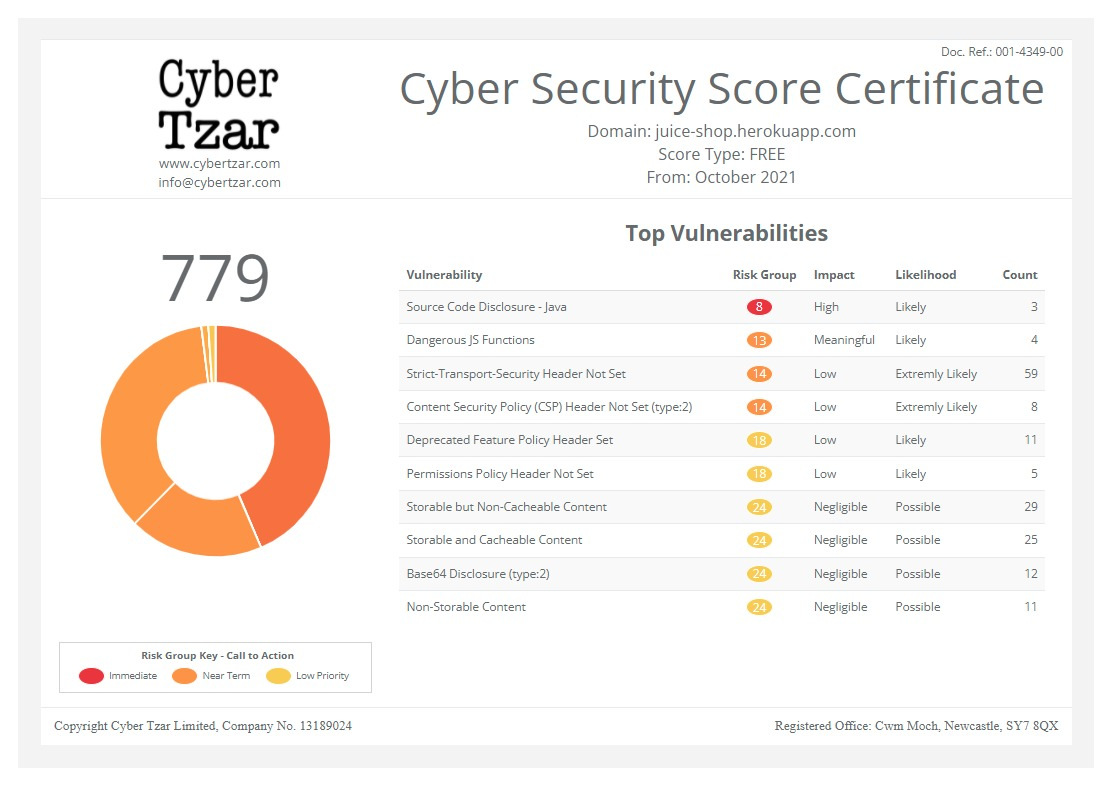
First slide label
Some representative placeholder content for the first slide.
Second slide label
Some representative placeholder content for the second slide.
Third slide label
Some representative placeholder content for the third slide.
Connecting the dots from port to port
published on 2026-10-08 06:30:00 UTC by Mark FletcherContent:
SJUK’s editor, Mark Fletcher, speaks to Cymoril Métivier, Global Digital Portfolio Director at Smiths Detection, and discovers that ports have been slow on the uptake in the global digital transformation
In the world of manufacturing, tighter integration, open platforms and intuitive standardisation are defining the new normal.
This technologically agnostic approach has revolutionised the way that many other end users source, select and deploy technologies, knowing that systems will work with each other, connect to each other, speak the same language and share essential operational information… with negligible translation, argument or hinderance.
Digital transformation and Industry 4.0 have taken this approach to another level, unleashing even wider and deeper levels of integration and data sharing.
The benefits of this interoperability are myriad and are certainly influencing technology deployments in other verticals, but it appears that some ports, port operators and even governments may have missed the memo.
Arguably this is one industry that would certainly flourish in a security and traceability sense if only its people, processes and technologies would talk to each other in both a digital and operational sense.
Cymoril Métivier explained to me what is happening in the world of ports, why technological uptake seems to lag and what opportunities exist. In the first instance we discussed the contemporary challenges facing the sector.
e-commerce
“The first and most obvious impact has been the significant growth in e-commerce,” Métivier explains. “Every port around the world has seen a huge growth in the influx of goods and alongside this we have seen a commensurate growth in the opportunities for criminal activity. Simply put, more containers mean more opportunities to hide illicit goods, and these range from badly manufactured toys to cocaine.
“But this increase in volume has presented operational challenges, too. In many ports there simply isn’t the infrastructure and bandwidth to check every single container, they can’t endlessly add scanners, people or dogs. And sitting between all of this is the need to maintain the logistics required for perishable and limited-shelf-life goods.
“This is where smarter screening and digital transformation come in. We need to ask ourselves: ‘How can we optimise our processes and keep countries secure by screening smarter?’”
The right security hardware and its effective deployment are core to addressing these issues, so the next question is what does “right” look like, and what can it achieve? We need to define where security fits into the equation and how it can support operations.
Optimise capabilities
Métivier explains: “I always say that as a technology business we are here to enable the security policies of our customers. With the technology available today there doesn’t need to be any sacrifices.
We can optimise application- and location-specific capabilities through digital applications, such as networking, data sharing and detection algorithms. Doing so we can save money from the operational expenses (OpEx) and use this to enhance and increase security. From where I stand there are only upsides.
“Operationally it makes lives easier, too, and here I am referring to aviation & ports. When you think about them like for like, both want security, both want passengers and cargo to get safely and efficiently from A to B, but both want to add security. The optimisation route here is via connectivity and data sharing… with aviation being a bit more advanced.
“If you can imagine internationally connected ports that could (and do in some cases) exchange waybills, ships can be checked before they even get ashore. This is just one small example; there is so much more that can be achieved through enhanced approaches that can help to unburden the people in the security role.
“Anything we can do to make their roles easier, more intuitive and faster is always welcome, but there is also a cultural aspect which we cannot ignore. This currently sits around the deployment of AI, which is unfortunately coupled to some horrible messaging, creating a fear, which, in turn, creates resistance.
Optimise processes
“What we’re actually doing is making life easier. I always say that AI in any of its many forms is there to optimise the process of the customer. It will not replace, it will optimise, boosting speed, ease of use and problems solving and underpinning quicker and easier location of illicit goods. There are so many tools out there to help the user, it’s just a shame that we scare people so much with misleading AI messaging.”
With the UK being an island, both geographically and, to a certain extent, economically, I asked if our ports and operational demands are any different to other countries.
“I’d like to think that everybody wants the same thing,” Métivier shares. “Optimisation of security and protecting our borders more efficiently. And just like everywhere else, this is driven by data insights, everybody now is addicted to data.
“In ports and aviation, in both the UK and globally, the needs are the same. We want to know everything – the how, the what, the where, the when and the why. And the answer to all these relies on our ports creating and sharing all that data. But this can only be achieved if they move towards standardisation, and not just in the UK and in maritime, I’m talking cross border and cross agency.
“Data communication and sharing must happen globally. When we achieve that, a whole new world will open up for customs agencies. There are good collaborations already, but globally, it would be so much easier to standardise data first for sharing.”
No clear standards or rules
So, the obvious question at this stage is why ports are so far behind. “Put simply, there are no clear standards or rules,” Métivier tells us. “In the UK it was mandated in 2024 that all airports had to update security screening to level C3, a clear standard to which multiple sites can adhere. But standards such as this do not exist or are not prescribed for high-energy scanning machines, such as those used in ports. As a result, when each country goes to tender, they know what they want from an end-result perspective, but there is no formal and easily comparable way of defining the desired outputs.
“Similarly, in aviation, the standard image format being rolled out is the Digital Imaging and Communication in Security (DICOS) Standard developed by NEMA. Conversely, in container scanning the UFF format is used.”
UFF is typically not a standard picture format, like JPEG or PNG, but rather a Universal File Format that is used for engineering, scientific and custom data. The issue is that a UFF file created by one vendor may not be natively readable by another, instantly restricting its wider use.
“We are very passionate about this and have taken the open-standard platform to heart,” Métivier enthuses. “As a result, in early 2027, we will launch an open, API-based solution called Electora, that will natively support open standards such as UFF and DICOS, allowing the interconnection of any equipment from any vendor into one platform. Using this approach, departure and arrival ports can much more easily share and interrogate each other’s data.
“The API will convert to open standards that will allow platforms to transact data from any machine, even enterprise-level solutions. We’re trying to close gaps and enable our customers technologically, while solving problems globally.”
Financially staggering
We then quizzed Métivier about the necessity for unform data. Some of the rationale is operationally obvious, while some is financially staggering.
“Data can be collected, analysed and put into context,” she explains. “If you join different pieces together you will arrive at a much more informed conclusion. Even simple data points such as scan images, the port of origin and product counts can be combined to create a much bigger picture.
“Sharing and standardisation will allow ports to optimise their abilities to counter the import of illicit goods and, just as importantly, increase tax revenue, which begs the question: why are politicians not on the case? And the cost of the equipment pales into insignificance when you see the figures.
“In European airports alone, cigarette tax revenue lost in 2024 was 14.9 billion euro,” Métivier elaborates. “Between 2023 and 2024, 64 billion euro in cash was smuggled into the EU and in 2024, 31 billion euro of narcotics flowed into the EU. Now add unscanned shipping containers into the mix and I think you very quickly get the scale of the issue… and the missed revenue and judicial opportunities.”
Given these facts, it is hard to see why there is not more investment, but Métivier does list a few barriers, including space, regulations, existing installed base and, interestingly – based on what we’ve just heard – budget.
“Airports have proved that it can be done,” Métivier concludes, “it’s now down to ports to mimic these advances. There are so many opportunities, and the technology does exist to help people close the gaps. Our Electora platform will certainly help, but an international change of mindset is needed, too.”
https://securityjournaluk.com/connecting-the-dots-from-port-to-port/
Published: 2026 10 08 06:30:00
Received: 2026 10 13 13:18:41
Feed: Security Journal UK
Source: Security Journal UK
Category: Security
Topic: Security
Views: 0
