Cyber Security News Aggregator
.Cyber Tzar
provide acyber security risk management
platform; including automated penetration tests and risk assesments culminating in a "cyber risk score" out of 1,000, just like a credit score.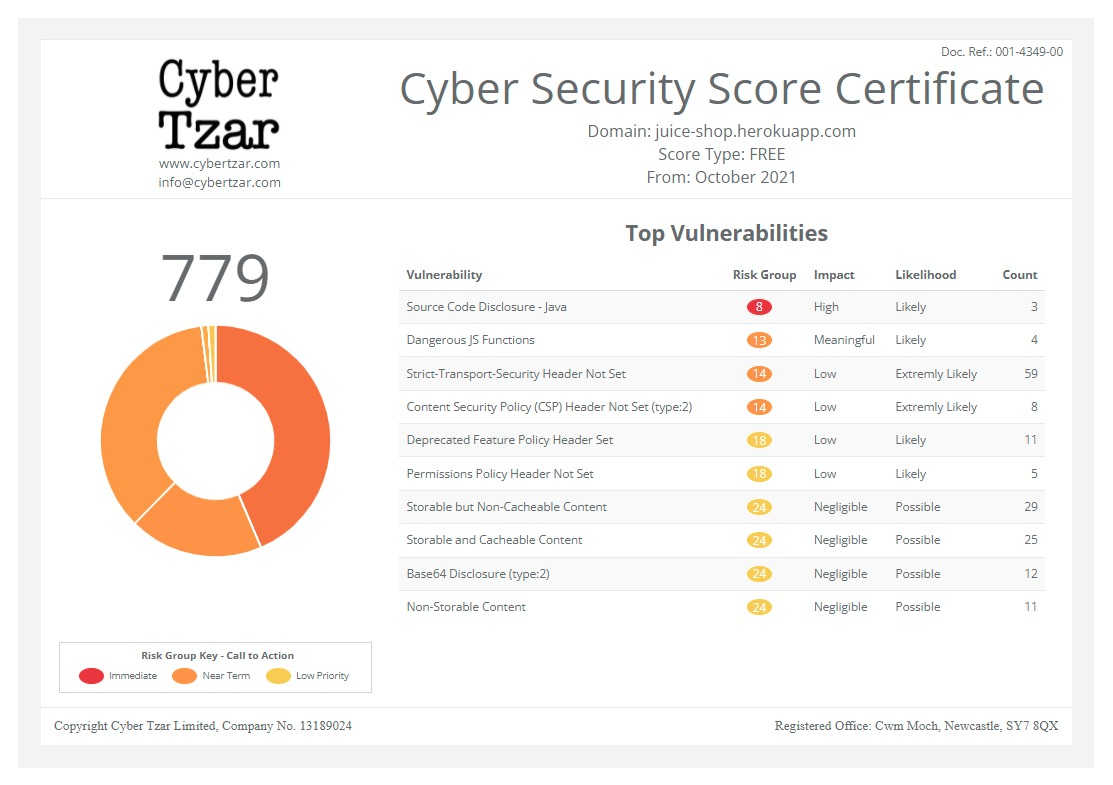
First slide label
Some representative placeholder content for the first slide.
Second slide label
Some representative placeholder content for the second slide.
Third slide label
Some representative placeholder content for the third slide.
Cybersecurity changes require doubling down on the basics
published on 2026-11-19 10:23:18 UTC by Mark FletcherContent:
Lewis Pope, Head Security Nerd at N-able, explains the evolving cybersecurity landscape and how the threats, affects and approaches are rewriting operational practices
A cloned voice can make a fraudulent phone call sound very convincing, and a phishing email can be written, personalized, and sent in the time it takes to read this sentence.
But look at what those attacks need in order to succeed and it’s something much more familiar. A reused password. A click on a link. A request nobody stopped to question.
AI hasn’t found attackers a new way in, it has made them far better at using the old ones.
Phishing is a numbers business. A campaign goes out to thousands of inboxes, a fraction of people opens it, a smaller fraction clicks, and a smaller fraction types in a password or approves a login prompt.
Attackers manage that funnel the way a marketing team manages theirs, and what AI has handed them is a better conversion rate.
Microsoft’s 2025 Digital Defense Reportcites AI-written phishing emails achieving a 54% click-through rate against roughly 12% for standard phishing. Same email, same ask, same stolen password at the end. Just far more people falling for it.
The technical security controls a business deploys are a fixed stage in that funnel.
An email security service filters out a phishing email… or it doesn’t. Multi-factor authentication (MFA) stops a login with a stolen password… or the attacker gets through.
Human judgement is the only stage that isn’t fixed. It varies with workload, time pressure, and how convincing the request happens to be, and it’s where attackers spend their effort, because it’s the only stage that moves.
So the fundamentals of cybersecurity are a long way from obsolete. If anything, the gap between businesses that have them and businesses that don’t just got a great deal more expensive.
Same tactics, sharper execution
Security researchers describe attacker behaviour in terms of tactics, techniques and procedures, where the tactic is the objective, the technique is the method and the procedure is the specific steps taken.
It’s a useful lens here because it separates what AI has changed from what it has left alone. The tactics are untouched. Impersonation, pretexting and credential harvesting have worked for two decades and still do. The change is in the technique, meaning how convincingly and how quickly those tactics are executed.
AI strips out the tells (poor grammar, generic phrasing, mistimed context) that once gave phishing away and makes it cheap to move to channels people scrutinise less.
The Verizon 2026 Data Breach Investigations Report, measuring text and voice phishing simulations at scale, found they drew a median click rate 40% higher than email simulations. The old advice for spotting a phish still holds. It just covers a shrinking share of the problem.
Everyday behaviour still creates openings
The UK Government’s Cyber Security Breaches Survey 2025/26 shows where that leaves businesses.
Phishing was experienced by 38% of UK businesses over the previous 12 months, and 69% of those hit by any attack named it the most disruptive.
Yet while 74% of businesses have a password policy, only 47% use two-factor authentication for networks or applications and just 19% ran any cybersecurity training or awareness activity for staff. The controls that blunt a better-converting phish are the ones least adopted.
Password hygiene shows how small habits become openings. Reuse one password across several accounts and a breach at any of them hands attackers a key to the rest. Share a password with a colleague, or leave it in a spreadsheet, and the same shortcut applies.
Regulators now treat these controls as a baseline duty of care rather than good practice. The ICO fined 23andMe £2.31 million in June 2025 after a credential-stuffing attack, noting the company had not mandated MFA on customer accounts.
Three months earlier it fined Advanced Computer Software Group £3.07 million over a ransomware attack that began with a customer account lacking MFA.
When the ICO published its own five steps for defending against AI-powered threats in May 2026, its second recommendation was security fundamentals: Cyber Essentials controls, MFA on remote access, admin accounts and email, strong passwords and patching.
Third-party IT providers are being pulled into the same frame. The Cyber Security and Resilience Bill, now at Report stage in the House of Lords, will for the first time bring managed services providers (MSPs) into direct regulatory scope, with initial incident notifications due within 24 hours.
The reasoning is simple. A provider with access into hundreds of client environments is a high-value target. For the businesses that use one, it’s also a useful filter. The providers who can already show how they enforce MFA and how they report incidents are the ones the Bill is about to make the standard, and there’s no reason to wait for the law to start asking.
Make the secure choice the easy choice
None of this should turn into a blame game. Most employees who create a security risk aren’t malicious insiders. They’re people trying to do their jobs who get distracted or rushed, and attackers build situations to exploit exactly that.
Nobody is going to become infallible, so the answer is to make secure behaviour easier and to put safeguards in place for the moments when somebody gets it wrong.
Training has to keep pace. An annual reminder not to click suspicious links goes only so far when the links are harder to recognise and increasingly arrive by text or phone call.
Staff need to know what suspicious activity looks like, how to report it, and that they’ll be backed for questioning an unusual request, even one that appears to come from the CEO. Technology then provides the safety net. Identity and access controls, MFA, a password manager, email security and monitoring for compromised accounts all cut the odds that one lapse in judgement becomes a breach.
There are three practical places to start, and no one needs deep technical expertise to take them.
Audit which accounts still allow an email-only password reset, which is often the weakest link in an otherwise solid password policy. Check against the Cyber Essentials requirement, in force since April 2026, that MFA be enabled on every cloud service where it’s available, bearing in mind that organisations on an older assessment cycle have until late October before the grace period ends.
And if an MSP runs some or all of this for you, ask them directly how they enforce MFA and what their incident-reporting process looks like. Identity threat detection and response tooling will do the ongoing version of this work, but the first pass just needs someone to ask the questions.
Cybersecurity will keep changing and businesses will have plenty of new threats to contend with. But resilience is built in the decisions made long before an attack arrives, and those decisions are the same ones they were before AI came along. Skipping them just costs more now.
https://securityjournaluk.com/cybersecurity-doubling-down-on-the-basics/
Published: 2026 11 19 10:23:18
Received: 2026 11 19 10:31:36
Feed: Security Journal UK
Source: Security Journal UK
Category: Security
Topic: Security
Views: 2
