Cyber Security News Aggregator
.Cyber Tzar
provide acyber security risk management
platform; including automated penetration tests and risk assesments culminating in a "cyber risk score" out of 1,000, just like a credit score.
First slide label
Some representative placeholder content for the first slide.
Second slide label
Some representative placeholder content for the second slide.
Third slide label
Some representative placeholder content for the third slide.
4HTTP2ROOT Cacti Guest Zero-Day: Root Cause and Detection
published on 2026-11-29 07:18:05 UTC by MayureshContent:
4HTTP2ROOT or 4HTTP2SHELL lets an anonymous attacker run shell commands on a Cacti server in four HTTP requests, but only when the Cacti guest user is turned on. There is no CVE, no advisory and no packaged release yet. Cacti committed a fix to the 1.2.x and develop branches on 28 November 2026. On 26 November 2026 a researcher who writes as ek0ms savi0r published a four-request chain against Cacti Core 1.2.31 with a working proof of concept. I read the write-up, then read the Cacti source at the 1.2.31 tag and the fix commits that landed about a day later. This post is what the code says, what the fix closes, what it leaves open, and how to find out if someone already used it on your server.
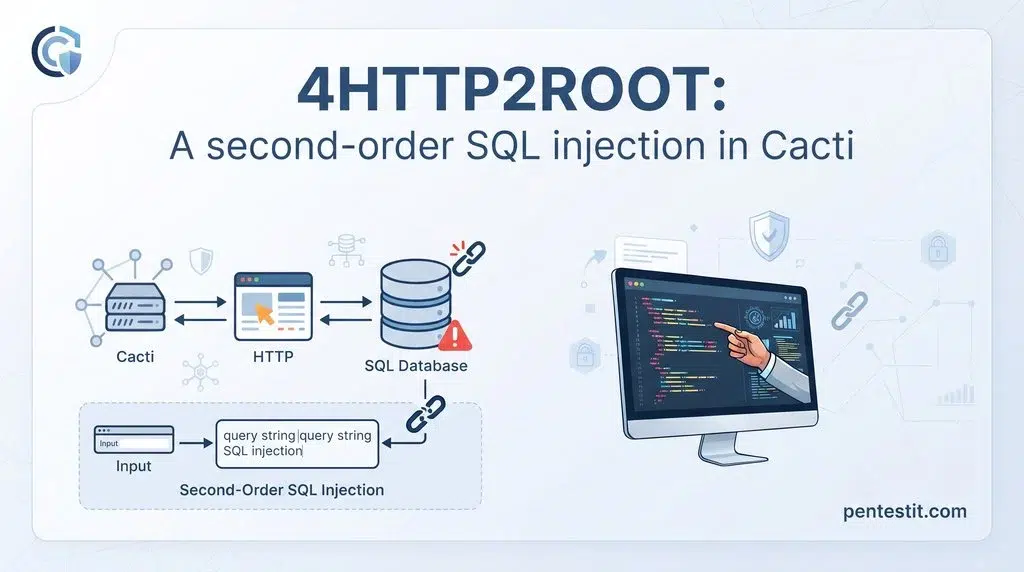
What is 4HTTP2ROOT?
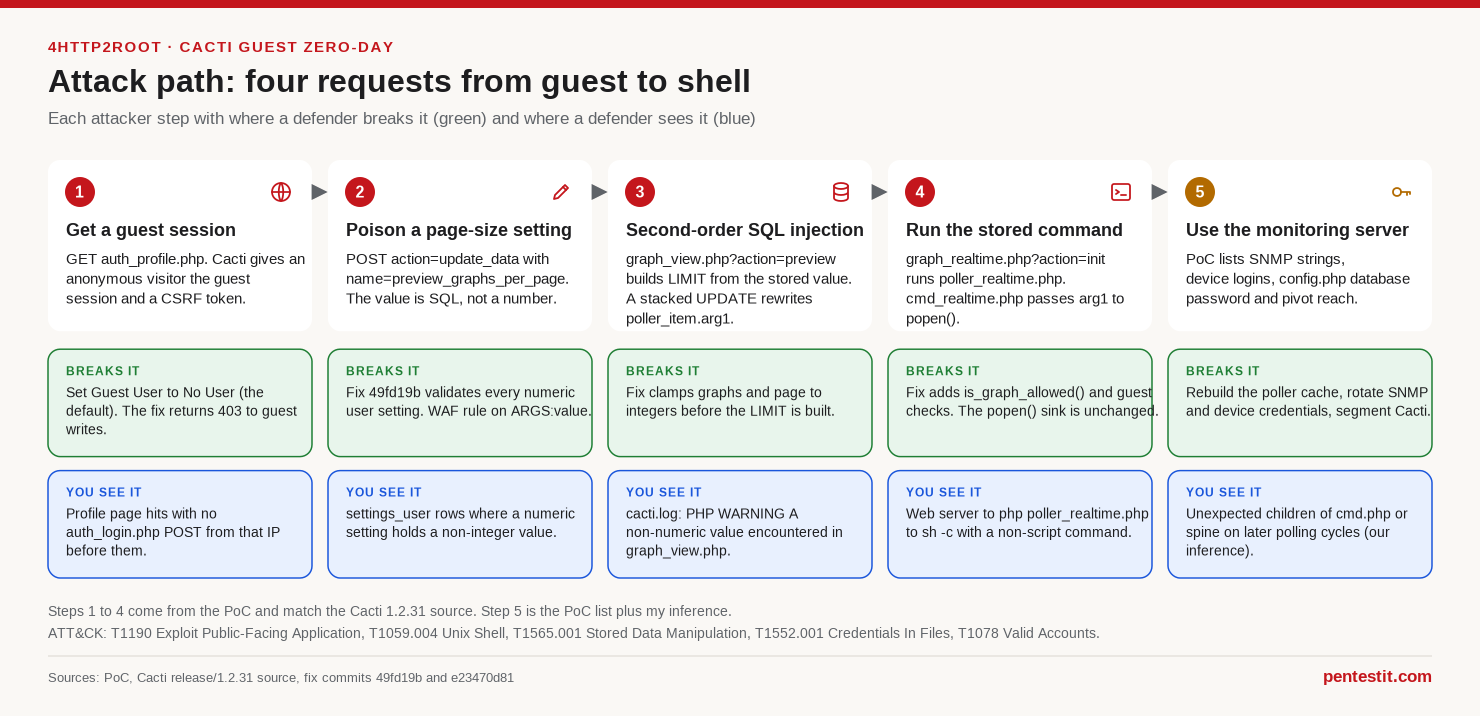
It is a stored, second-order SQL injection that ends in command execution. A guest saves text where Cacti expects a page size. A later page builds a SQL LIMIT clause from that saved text, and the database runs a second statement that rewrites a poller command. A realtime graph request then runs that command through popen().
4HTTP2ROOT: Root cause
The researcher describes four stacked failures. All four hold in release/1.2.31. I found a fifth that explains why an attacker with a guest account can reach the realtime poller at all.
- Guest pages skip the realm check. In
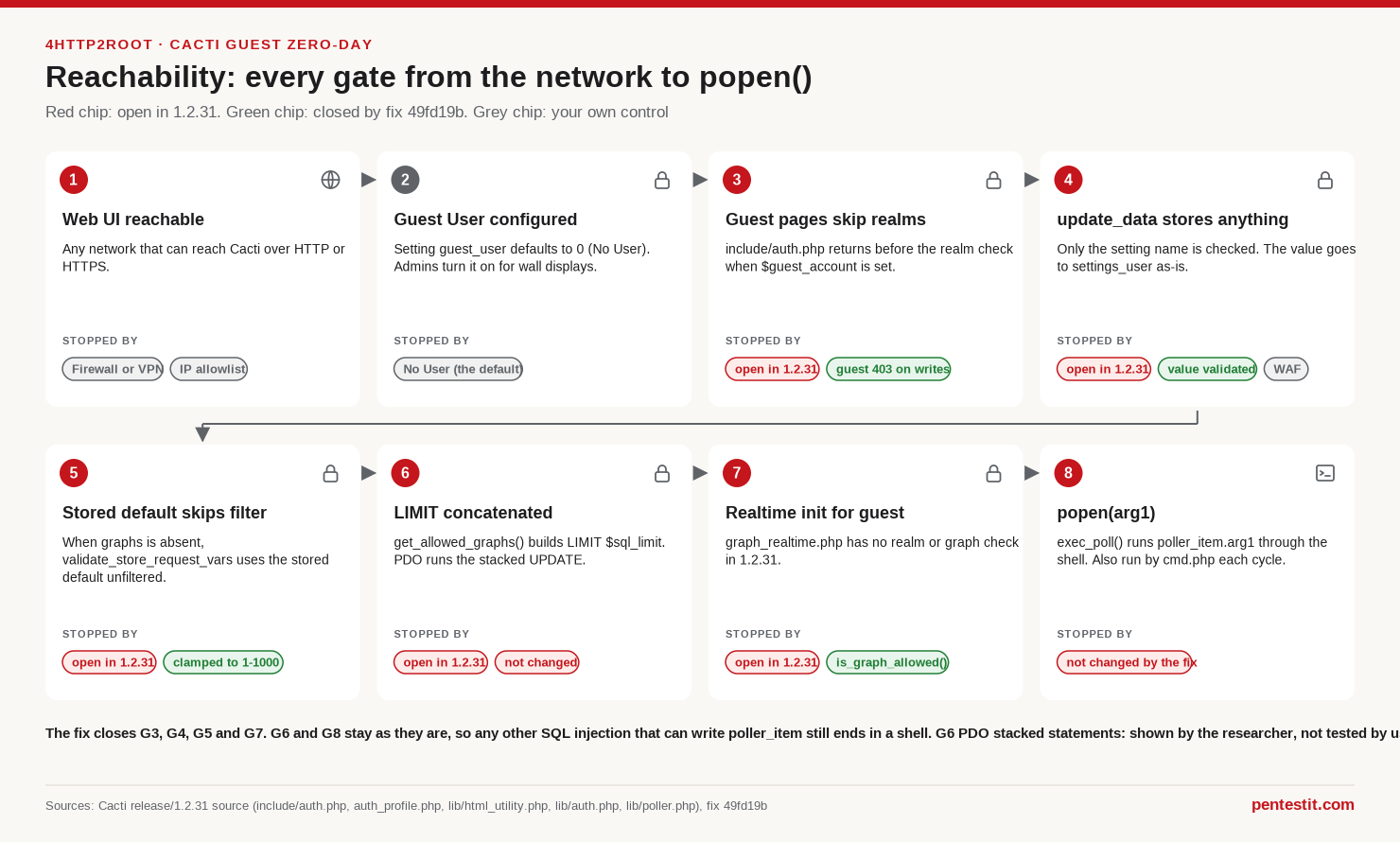
include/auth.php, a page that sets$guest_account = truereturns before the realm permission lookup.auth_profile.php,graph_view.phpandgraph_realtime.phpall set it. The default guest account only holds the graph view realm, but that does not matter on these pages.graph_realtime.phpin 1.2.31 has no realm or graph check of its own. - Any value goes into a numeric setting.
auth_profile.php?action=update_datachecks that the setting name exists in$settings_userand then stores the value with a preparedREPLACE. The storage is safe. Nothing checks thatpreview_graphs_per_pageis a number. - The stored default skips request validation.
html_graph_validate_preview_request_vars()declaresgraphswithFILTER_VALIDATE_INTand a default ofread_user_setting('preview_graphs_per_page', 20). When the request carries nographsparameter,validate_store_request_vars()copies the default in without filtering it. - The value is concatenated into SQL.
graph_view.phpbuilds$limitfromgraphsandpage, andget_allowed_graphs()appendsLIMIT $sql_limit. The researcher reports that PDO ran the stackedUPDATE. I did not test that part. - A database row becomes a shell command.
cmd_realtime.phppassespoller_item.arg1toexec_poll(), which callspopen().cmd.phpdoes the same for every script data source on every polling cycle.
I reproduced one link in PHP 8.3: multiplying the poisoned value raises A non-numeric value encountered and produces a LIMIT string that starts 0,1;UPDATE. Cacti’s error handler logs that warning to cacti.log, so this is the cheapest detection you have. The line numbers in the write-up (graph_view.php:657, lib/auth.php:1574-1578) match the unreleased 1.2.x branch, which reports version 1.2.32. In the 1.2.31 tag the same code sits at line 487 and line 1478. My reading is that the lab ran the development branch. The code pattern is identical in the 1.2.31 tag, so I still treat 1.2.31 as affected, but nobody has published a test on the packaged 1.2.31 release.
Which Cacti versions are affected?
I checked every release/1.2.x tag from 1.2.10 to 1.2.31. All 22 carry the same three pieces: the unvalidated update_data write, the setting-backed default, and the concatenated preview LIMIT. That is a code match, not a lab test, and older releases have other guest holes on top.
| Build | Version | Status | Watch out |
|---|---|---|---|
| Upstream release | 1.2.31 (15 June 2026) | Affected, guest on | 1.2.31 was the fix for June’s guest pre-auth SQL injections. Upgrading for those did not cover this. |
| Upstream 1.2.x branch | 1.2.32-dev before 49fd19b | Affected (researcher lab) | The 6 November POST and CSRF backport does not help. The guest owns a valid token. |
| Upstream 1.2.x branch | 49fd19b and later | Fixed in source | No tarball. Eight files change; test before deploying. |
| Upstream develop | e23470d81 and later | Fixed in source | Same fix, develop line. |
| Older upstream | 1.2.10 to 1.2.30 | Same code | Also open to the June 2026 advisories. |
| Debian | bullseye 1.2.16, bookworm 1.2.24, trixie 1.2.30, forky and sid 1.2.31 | Same code, no distro fix | No CVE, so no tracker entry will appear yet. |
| Fedora EPEL | EPEL 8 and 9: 1.2.30 | Same code, no distro fix | Also older than the June fixes. |
| Ubuntu | Focal 1.2.10; newer series not checked | Same code where 1.2.x | I did not confirm the current series. |
What the fix closes and what it leaves
Commit 49fd19b (pull request 9014, merged 28 November 2026) and its develop twin e23470d81 return 403 to guest writes on the profile and realtime endpoints, validate every numeric user setting against its schema, clamp graphs and page to integers before the LIMIT is built, and add is_graph_allowed() before realtime runs the poller. Neither commit mentions 4HTTP2ROOT, a GHSA or a CVE.
Two things stay as they were. get_allowed_graphs() still concatenates whatever LIMIT it is given, and exec_poll() still hands poller_item.arg1 to a shell. The fix breaks this chain at the input. Any other SQL injection that can write poller_item still ends in a shell, and Cacti published several SQL injection advisories this year.
I reproduced one link in PHP 8.3: multiplying the poisoned value raises A non-numeric value encountered and produces a LIMIT string that starts 0,1;UPDATE. Cacti’s error handler logs that warning to cacti.log, so this is the cheapest detection you have. The line numbers in the write-up (graph_view.php:657, lib/auth.php:1574-1578) match the unreleased 1.2.x branch, which reports version 1.2.32. In the 1.2.31 tag the same code sits at line 487 and line 1478. My reading is that the lab ran the development branch. The code pattern is identical in the 1.2.31 tag, so I still treat 1.2.31 as affected, but nobody has published a test on the packaged 1.2.31 release.
Which Cacti versions are affected?
I checked every release/1.2.x tag from 1.2.10 to 1.2.31. All 22 carry the same three pieces: the unvalidated update_data write, the setting-backed default, and the concatenated preview LIMIT. That is a code match, not a lab test, and older releases have other guest holes on top.
| Build | Version | Status | Watch out |
|---|---|---|---|
| Upstream release | 1.2.31 (15 June 2026) | Affected, guest on | 1.2.31 was the fix for June’s guest pre-auth SQL injections. Upgrading for those did not cover this. |
| Upstream 1.2.x branch | 1.2.32-dev before 49fd19b | Affected (researcher lab) | The 6 November POST and CSRF backport does not help. The guest owns a valid token. |
| Upstream 1.2.x branch | 49fd19b and later | Fixed in source | No tarball. Eight files change; test before deploying. |
| Upstream develop | e23470d81 and later | Fixed in source | Same fix, develop line. |
| Older upstream | 1.2.10 to 1.2.30 | Same code | Also open to the June 2026 advisories. |
| Debian | bullseye 1.2.16, bookworm 1.2.24, trixie 1.2.30, forky and sid 1.2.31 | Same code, no distro fix | No CVE, so no tracker entry will appear yet. |
| Fedora EPEL | EPEL 8 and 9: 1.2.30 | Same code, no distro fix | Also older than the June fixes. |
| Ubuntu | Focal 1.2.10; newer series not checked | Same code where 1.2.x | I did not confirm the current series. |
What the fix closes and what it leaves
Commit 49fd19b (pull request 9014, merged 28 November 2026) and its develop twin e23470d81 return 403 to guest writes on the profile and realtime endpoints, validate every numeric user setting against its schema, clamp graphs and page to integers before the LIMIT is built, and add is_graph_allowed() before realtime runs the poller. Neither commit mentions 4HTTP2ROOT, a GHSA or a CVE.
Two things stay as they were. get_allowed_graphs() still concatenates whatever LIMIT it is given, and exec_poll() still hands poller_item.arg1 to a shell. The fix breaks this chain at the input. Any other SQL injection that can write poller_item still ends in a shell, and Cacti published several SQL injection advisories this year.
Reachability gates in Cacti 1.2.31
How hard is it to exploit 4HTTP2ROOT?
4HTTP2ROOT
- Four plain HTTP requests, no credentials, no race, no memory layout high: Public write-up names every endpoint and parameter mid: Needs a poller_item row with local_data_id the attacker can target (row 1 in the researcher's lab) low: Guest User is No User by default, so most installs are not reachable outcome: Shell as the web or poller account. Access to config.php and every stored SNMP and device credential.
Easy where guest is on
Mass exploitation is possible, but only on a minority of installs
4HTTP2ROOT Timeline
The write-up went public on 26 November with no vendor notice reported. watchTowr’s FAQ followed at 20:09 UTC. Cacti committed fixes at 01:24 and 01:28 UTC on 28 November, between 29 and 49 hours later, depending on the hour of publication, which nobody has stated. CISA KEV release 2026.11.27 does not list it, and nobody has reported exploitation.
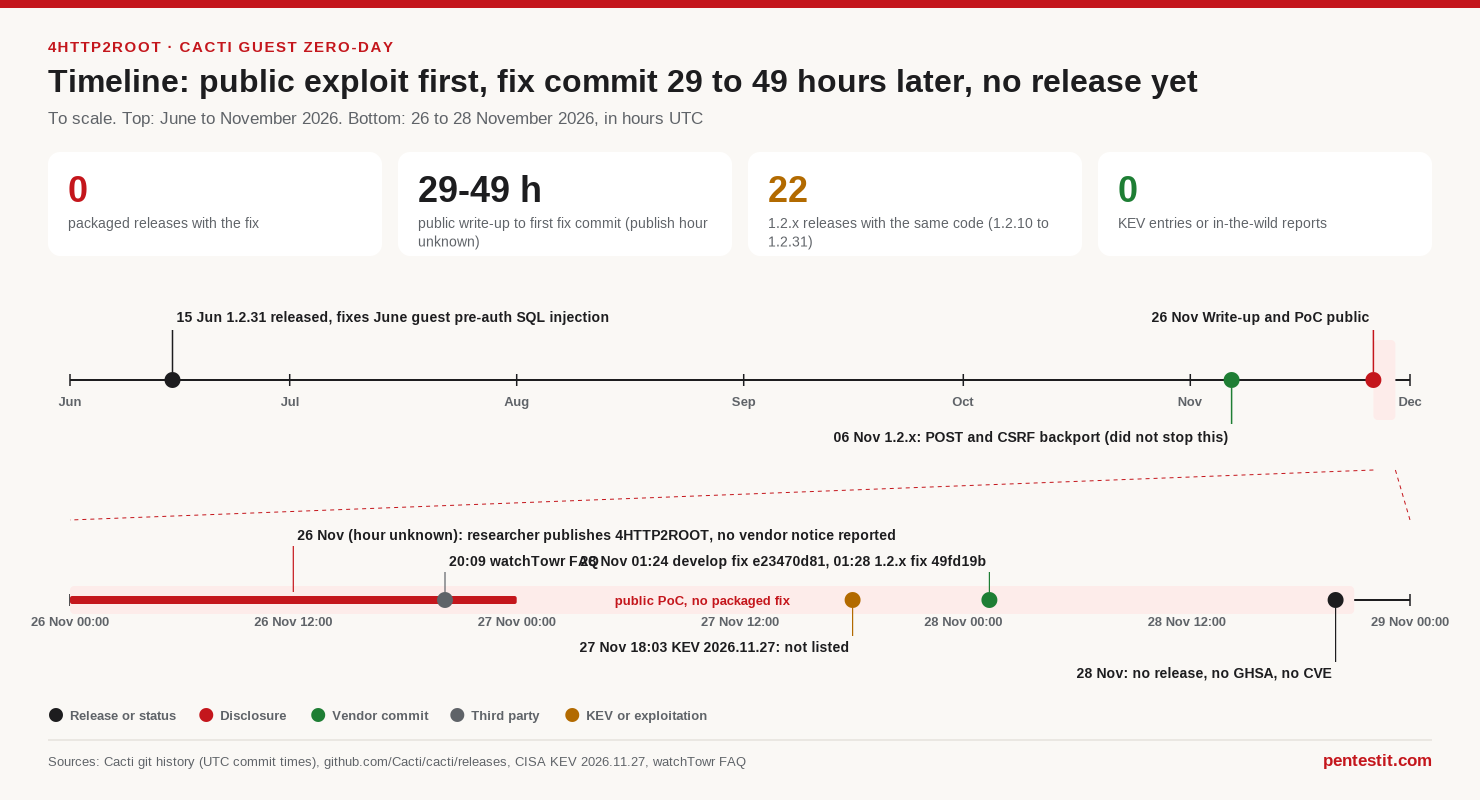
The write-up went public on 26 November with no vendor notice reported. watchTowr’s FAQ followed at 20:09 UTC. Cacti committed fixes at 01:24 and 01:28 UTC on 28 November, between 29 and 49 hours later, depending on the hour of publication, which nobody has stated. CISA KEV release 2026.11.27 does not list it, and nobody has reported exploitation.
What should Cacti owners do first?
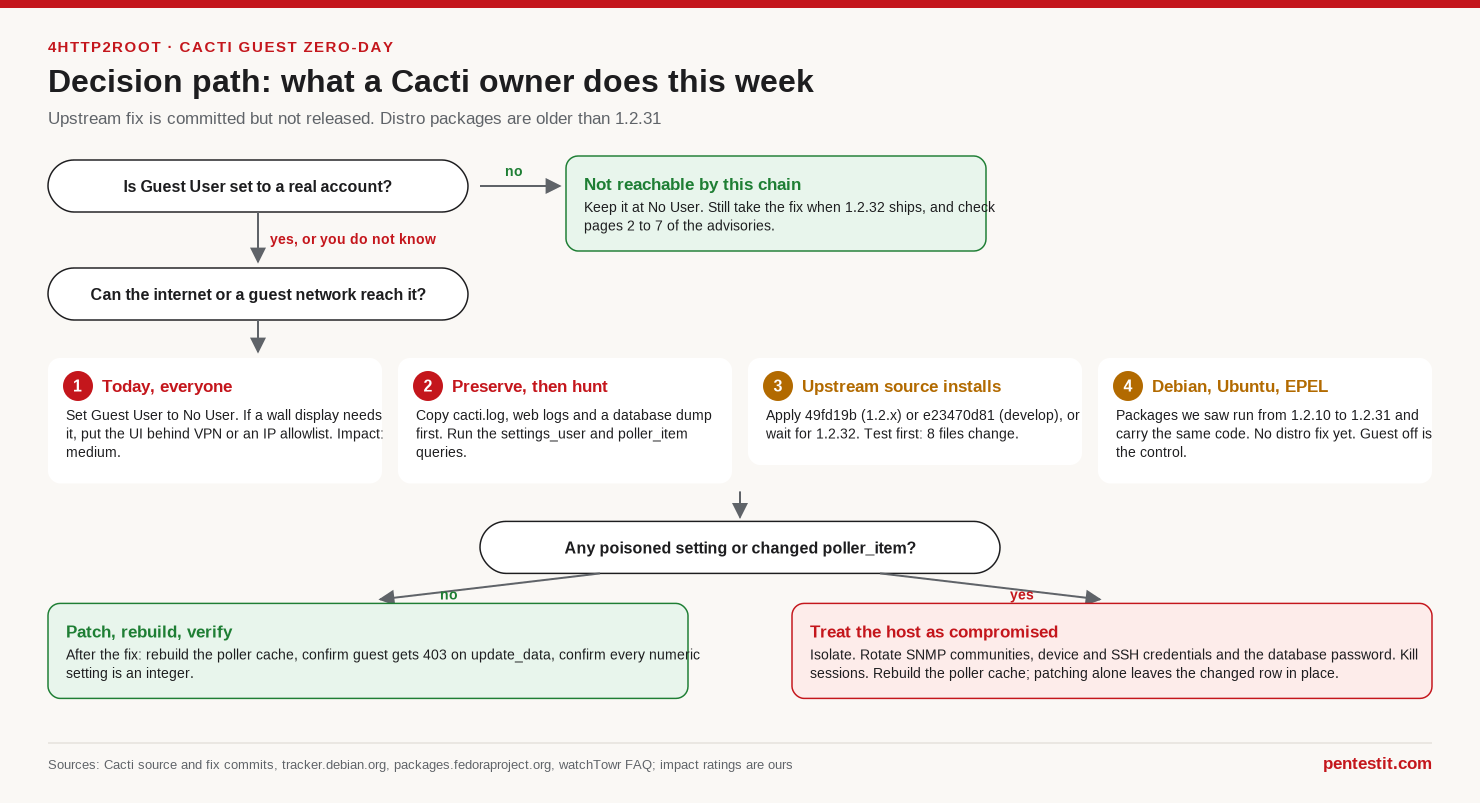
- Set Guest User to No User (impact: medium). Console > Configuration > Settings > Authentication. Wall displays lose anonymous access; give them a named read-only account.
- Restrict the web interface (impact: medium). VPN or an IP allowlist in front of Cacti. This also covers the next SQL injection.
- Patch (impact: medium to high). Apply
49fd19bto a 1.2.31 source install after testing, or wait for 1.2.32. Distro users have no package yet, so steps 2 and 3 are the control. - After patching (impact: medium). Rebuild the poller cache, clear sessions, and confirm a guest gets 403 on
update_data. - If you find a poisoned row (impact: high). Isolate the host. Rotate SNMP communities, device and SSH credentials, the database password and mail relay credentials. Look for pivots from the Cacti host into management networks.
Detecting 4HTTP2ROOT Exploitation Attempts
The full Sigma, Zeek and ModSecurity bodies are in my Sigma repository.
- cacti.log:
A non-numeric value encounteredingraph_view.phpon PHP 8, orA non well formed numeric value encounteredon PHP 7. High fidelity. - Database: any numeric setting in
settings_userthat is not an integer, and any scriptpoller_itemwhosearg1points outside the scripts directory or carries shell syntax.poller_item.last_updatedmoves on update, which helps date the write. - Process:
/bin/shstarted byphp poller_realtime.phporcmd.phpwithout/scripts/in the command line. - Filesystem: a new
.phpfile under the Cacti webroot written by the web server or poller account, not by a package manager. This catches the web-shell variant, which no database query will show after the attacker restores the poller row. An auditd watch on the webroot and a Sigma file-creation rule are in the repository. - Web and Zeek: a client that hits
auth_profile.phpwithaction=update_dataand thengraph_realtime.php?action=initwithout ever posting toauth_login.php. Hunting only: the Cacti front end putsaction=update_datain the URL for normal profile edits too. - ModSecurity: deny
update_datawhen the setting is one of the 23 numeric names from the fix and the value is not an integer.
FAQ
Is my Cacti server vulnerable to 4HTTP2ROOT?
Only if Guest User is set to a real account and someone untrusted can reach the web interface. The code pattern exists in every 1.2.x release from 1.2.10 to 1.2.31.
Is there a patch for 4HTTP2ROOT?
There is a source fix, commit 49fd19b on the 1.2.x branch and e23470d81 on develop, both from 28 November 2026. There is no packaged release yet.
Does 4HTTP2ROOT give root?
It gives whatever account runs the Cacti web server and poller. That is root only if you run them as root.
Does updating to Cacti 1.2.31 protect me?
No. 1.2.31 is the version the researcher targeted. It fixed the June 2026 guest SQL injections, not this one.
https://pentestit.com/4http2root-cacti-guest-zero-day/
Published: 2026 11 29 07:18:05
Received: 2026 11 29 08:06:33
Feed: PenTestIT
Source: PenTestIT
Category: News
Topic: Security Tooling
Views: 0
